
Why I love debates
All-candidates debates are full of surprises

We have reached the point in the election when local debates will start taking place, and politicians will make their cases directly to voters — or not.
I love debates. All-candidates debates were my first introduction to politics. I attended them in high school for an opportunity to ask the candidates questions. Usually I would approach them before or after the actual debate part when they were just milling about and I could speak to them directly. I was comfortable speaking at a mic — I was an avid theatre kid — however, publicly asking politicians about the safety of queer youth in schools (an issue I was agonizingly familiar with) required more courage than I had at the time.
Fresh out of high school and newly eligible to vote, I decided during the 2006 election that I wanted to meet the candidates for North Okanagan-Shuswap personally. I emailed the candidates, asking them if they could answer some questions about the safety of GLBT youth (queer wouldn’t enter the acronym until a few years later). The next morning I got up early to drive my little Dodge Colt from my hometown of Salmon Arm to Vernon to visit the candidates’ campaign offices. I had a set of questions written down. Same-sex marriage was only made legal the summer before, so a question regarding the safety of queer students in schools was one they weren’t used to being asked.
Three of the candidates had offices: the NDP, the Liberals and the Conservatives. All of the campaign offices were quiet, and I was able to meet with all three candidates.
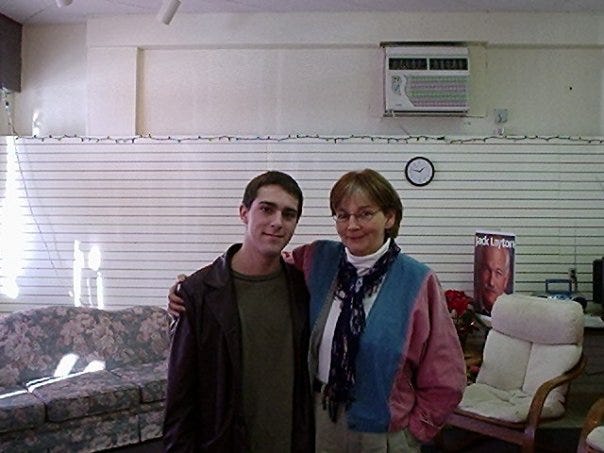
The NDP candidate, Alice Brown, had received my email. Her first comment was, “none of us in the office know, what does that acronym stand for, GLBT?” This set the tone for the day. When I told her, she gave an “aha” and spoke about her party’s support for gay and lesbian people and voiced her personal support for any vote on same-sex marriage. I learned a valuable lesson about defining acronyms if you want to communicate clearly.
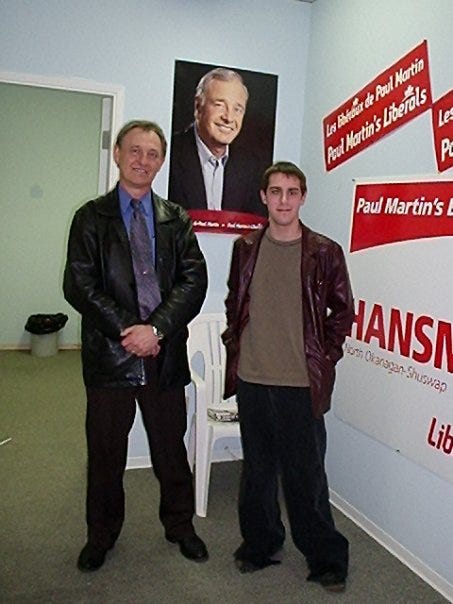
The Liberal candidate, Will Hansma, hadn’t received my email, so I asked him my questions directly. He seemed shocked, and, in response to pretty much all of them, told me he would do whatever his party told him to. I appreciated his honesty. He did not do well in the election, but keep in mind this was the riding that Pierre Elliot Trudeau gave the middle finger to. He said something about personally supporting same-sex marriage if it came to a free vote, which at that point I really wanted to say wasn’t the question I was asking, but I was genuinely curious where all the candidates stood on that too so I allowed it.
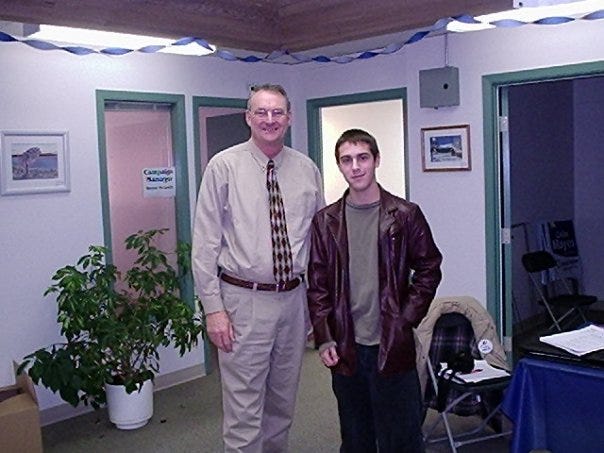
The Conservative candidate, Colin Mayes, told me he had not checked the email inbox yet that morning. I sat down I told him the premise of my questions — I think I worded it, “I have questions about the safety of gay, lesbian, bisexual and transgender students,” and then I said something along the lines of, “I don’t know how you might feel about these questions”. His response to my comment started a conversation that was maybe one of the most pivotal in my life. It was significant enough to be featured in the local newspaper six years later. I saw in him the best of what a politician can be for his constituents. He won the election handily.
After I had interviewed all the candidates, I got myself some food and went to that evening’s debate, excited to see the people I had just met in action and hoping I could catch some of the other candidates on the ballot with my questions. The debate started, and Brown and Hansma focused their attacks on Mayes. Having just had pleasant conversations with all of them, it seemed a bit much the way they were piling on.
Then something surprising happened: someone stepped up to the mic and asked one of my questions about school safety for queer youth, almost word-for-word.
Suddenly the debate took on a completely different lens for me. I had seen them take this question without any preparation. I had written down their answers. But now I got to see how they responded having put some time into it, and in front of an audience of voters and not just me in their office.
Brown had clearly been thinking about it, because she gave a way more forceful answer than before. She had memorized the acronym now. I don’t remember her response exactly, but it was great. For a young, gay person just getting involved, to see someone take my question, give it some thought, and turn it into a solid speech in one day made my heart sing.
Mayes spoke next, and while he did not share the same personal thoughts he did with me in our conversation, the principles of his answer were basically the same — if I remember correctly (it has been almost two decades) it was along the lines of everyone deserves to feel safe and he would do everything he could to ensure youth were. I remember thinking, like the NDP candidate, he gave a more thorough answer having had some time to think about it.
Hansma started… so well. He talked about his party’s support for same-sex marriage, and then he said, “I actually met with a young man today who asked this exact question…”
I just want to pause and remind you again that this was 2006, same-sex marriage was only freshly legal, the Spitzer Report claiming conversion therapy worked hadn’t yet been recanted, the Westboro Baptist Church was still picketing funerals and “Don’t Ask Don’t Tell” was the US military’s actual policy regarding gay people.
“…by this young man sitting in the front row!” he said as he pointed directly at me.

Nothing happened — other than me feeling very nervous and spending the rest of the debate looking around to see if anyone was looking at me funny. But that moment will also stick with me as a highly specific “do not do” I recommend to candidates doing debate prep.
Good on him though, I seem to remember he gave a better answer than “whatever my party tells me to do”. Again, he had thought about it, which was true for every candidate I had spoken with. After that the rest his answer is a blackout in my memory, but my notes said nice things about whatever he said.
Fundamentally, they all gave the same answers they had given me earlier in the day, but this time they presented those answers to a packed crowd of voters. I got to see the difference between how a politician speaks when it’s just them and some teenager walking into a campaign office and a crowd of hundreds on an issue where giving the same answer may upset some of the people who support you.
This is where my love of debates comes from. It is an opportunity to see candidates give their stump speech, probably well-rehearsed and polished, and then respond to familiar questions they’ve been getting at every debate. Then, you get to see them think on their feet, giving an answer to an unexpected question that may reveal more about them than they intended. Sometimes it’s a combative trainwreck. And sometimes you get to see three thoughtful, engaged candidates evolve in real time on something that hadn’t been on their radar the day before.
Afterwards I spoke with Mayes. I told him I thought the other candidates had been too harsh to him in the debate, and wished him well. When he checked his email after he was elected, I was the first congratulation he received.