
Defunded
The government insists it didn't "defund" SOGI 123, they just cut all provincial funding

Content warning: suicide
“An exchange student who has to cover his two black eyes, a teacher who is desperately afraid of losing one of her students, a former bully who had to come to terms with her own gender identity, a CEO who brought over $100 million of revenue to the Lower Mainland who wanted to kill himself as a child, a violinist who had absolutely nobody to turn to in school, a comedian who credits a single teacher with saving his life in school, a parent who is absolutely stunned by the open-mindedness of two Grade Threes.
“These are just a few of the many, many letters that we’ve received from people all over British Columbia, sharing their stories about what life is like, not just for them but for the people around them and how homophobia and transphobia affects them.”
My speech at Vancouver City Hall, October 20, 2011
It’s 2003. Summer. I was 16.
My phone rings.
I’m at my house, hanging out with a group of friends. Just four of us, watching movies. My house was the only one we could watch queer movies at, so I often had friends over for movie nights.
The person calling was someone I had met through a drop-in group for queer youth. I did not think I knew him well, so I was surprised he was calling.
He was not speaking clearly. He was upset. He said he felt hated and isolated. He believed he could never be loved — he’d been convinced of that by his family and fellow students at his school. He told me he was calling because I had been kind to him and he wanted to say goodbye.
By the time he admitted he had swallowed a bottle of pills, my friend was already on the phone to 9-1-1.
Over an hour that felt like a year, we convinced him to tell us where he was. One friend drove, while another stayed on the line with emergency services. I stayed on a cell phone, sitting in the backseat, and kept him talking. The battery was dying.
We arrived at his house at the same time an ambulance did. I rode with him to the emergency room, where they pumped his stomach. We returned to my house, where he slept in my bed and the rest of us slept on our couches. The next morning, we drove him home.
For years I never put my phone on silent. At least two more calls like that happened before I finished high school.
Mission accomplished?
The BC Conservatives declared victory this past week with the announcement that the Ministry of Education is discontinuing funding to the ARC Foundation, a registered charity which created and maintains the SOGI 123 resources that are used in schools to support queer students. After years of agitating and attacking the program, they claim they have finally been successful in making schools less safe and inclusive for diverse students. Bravo (sarcasm).
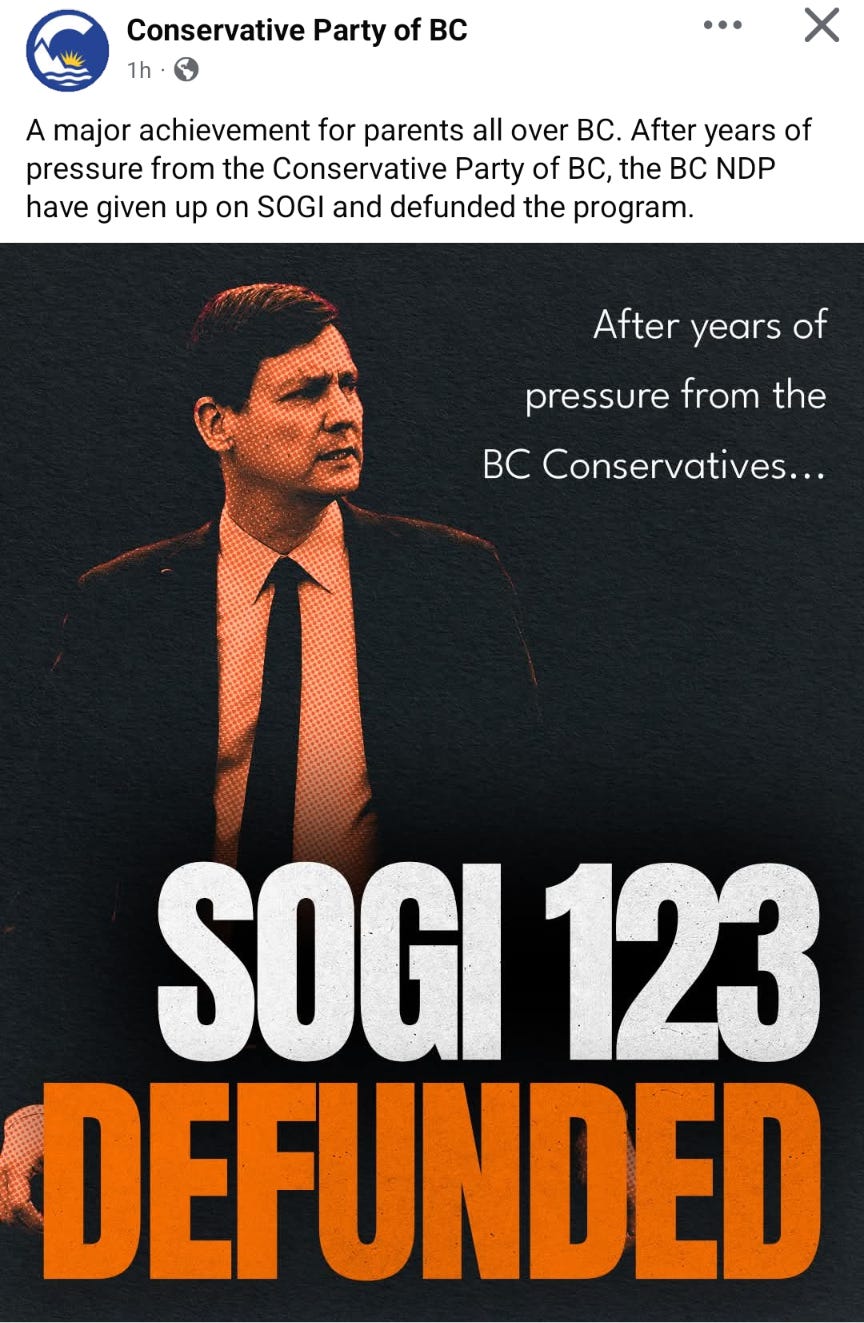
Of course, the Conservatives are significantly misrepresenting what happened. SOGI 123 itself is not “defunded” entirely, as the ARC Foundation receives funds from several different sources. However, it does appear the provincial government has cut all of the funding they were providing, which included both ongoing operational funding and contract funding for the development of materials.
I was a part of the efforts that led to SOGI 123. In 2010 I helped organize a vigil in response to the significant number of queer students that committed suicide in our province each year. Having only recently graduated from high school, I felt like I understood the pressure, pain and hostility that my fellow queer students faced.
After the vigil, a few friends and I got together to talk about what we could do to follow up on the momentum we felt we had. I was particularly passionate about seeing explicit anti-homophobia and anti-transphobia policies implemented in schools, as my home district had not had one.
Victoria implemented the first anti-homophobia policy in British Columbia in 2001, but the rest of the province had been slow to move. At the time of the vigil, only 11 of BC’s 60 districts had anything on the books.
“Our extrapolation of the findings suggests [the presence of anti-homophobia policies in schools] could help prevent suicide attempts for 3 out of 8 LGB students who might be at risk in a typical B.C. high school…”
Saewyc E., Poon C., Kovaleva K., Tourand J., & Smith A. (2016). School-based interventions to reduce health disparities among LGBTQ youth: Considering the evidence. Vancouver: McCreary Centre Society & Stigma and Resilience Among Vulnerable Youth Centre.
The work to bring in policies and resources for queer students had already been underway for years — the Corren Agreement, the Safe School Task Force, and the Surrey book banning fiasco were all significant milestones — but my involvement began after that vigil.
Purple stories
There was a letter-writing campaign that took place in New Zealand in support of same-sex marriage, led by out Olympic speedskater Blake Skjellerup. I had met Skjellerup at Vancouver Pride the previous year and was following him on social media. The campaign seemed to be a great way to get the attention of politicians — written letters had become less common in the age of email, so a bunch of letters in coloured envelopes arriving at elected officials’ offices would be noticeable.
A group of us came together and started organizing. We launched our campaign — the Purple Letter Campaign — and called on British Columbians to write the Minister of Education in support of implementing anti-homophobia and anti-transphobia policies in every school district.
It took off. We set up purple mailboxes in cafés across BC, and spent the summer touring small towns holding small events. We started receiving letters in a post office box we had rented almost immediately, along with emailed letters that people asked us to print. By the end of the campaign, we had around 500 letters to deliver, not including ones people sent directly to the Minister’s office or to their local MLA.
The campaign attracted a lot of allies. The Mayor of Vancouver, Gregor Robertson, declared October 20th, 2011 “Purple Shirt Day” in a ceremony at city hall. The Conservative Member of Parliament for my hometown, Colin Mayes, attended a public event and wrote a letter in support. BC Liberal MLA Linda Reid hosted a mailbox in her constituency office. I met with Green leader Jane Sterk in a café in Vancouver, and she made sure their party included a call for anti-homophobia policies in their 2013 election platform.

The BCNDP also supported the campaign. Individual MLAs and MPs wrote and spoke in support. They did some media around calling on the Liberals to introduce policies, though their 2013 platform mentioned homophobia only once, on page 17, with a vague commitment to “ensure that students are respected, and that policy exists to deal effectively with homophobia, racism, sexism, transphobia and other forms of systemic discrimination.”
The BC Liberals, on the other hand, reached out to me and set up a meeting with George Abbott, the Minister of Education at the time. When we were introduced as guests in the legislature, they mentioned our campaign by name.
“The purple letters are a call to each and every one to make British Columbia the leader against homophobic and transphobic bullying in every part of our province and frankly, honourable Members, in each of our ridings.”
MLA Linda Reid, Hansard, October 20, 2011
It took until 2016 — 15 years after the first policy was passed — to see policies in all districts. The Minister of Education passed a ministerial order requiring policies in all schools, alongside the introduction of the SOGI 123 program, in 2016. The first pillar of SOGI 123 was policy and procedure resources, helping school districts develop local policies for addressing homophobia and transphobia.
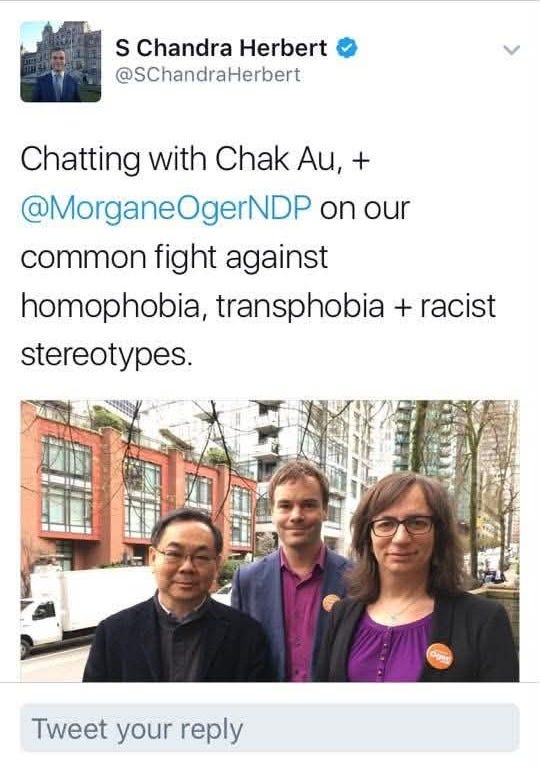
A year later, in the 2017 election, the BCNDP decided to run a candidate with a long history of opposition to same-sex marriage, Chak Au, against BC Liberal MLA Linda Reid, who had been her party’s biggest supporter of our Purple Letter Campaign. When Au was asked about it, he said his views had not changed and that NDP leader John Horgan promised him he could vote his conscience on “sensitive” moral issues. According to him, it had been a condition of agreeing to run.
In response, the BCNDP sent MLA Spencer Chandra-Herbert and another queer candidate to take a photo with Au and insist he was definitely not homophobic. Au lost, flipped to Pierre Poilievre’s federal Conservative Party, and is now the Conservative MP for Richmond Centre—Marpole.
What does SOGI even mean?
SOGI as an acronym means “sexual orientation and gender identity”. The SOGI 123 program was developed as a response to a series of queer youth suicides that were directly connected to the violence and hostility from their school environments. The partnership with the ARC Foundation was introduced by the BC Liberal government in 2016 under Premier Christy Clark.
SOGI 123 has been consistently misrepresented by opponents. It has been described as a mandatory curriculum, which it is not. It has been dismissed as forcing queer content on youth without reason, ignoring the ridiculously high suicide rate that preceded it. There is so much blatant misinformation about SOGI 123 that multiple school district websites have to have notices addressing all the myths.
SOGI 123 connects educators to proven tools and resources for aligning schools with provincial policies protecting people of all sexual orientations and gender identities (SOGI). SOGI 123 focuses on three key areas:
(1) policies and procedures (e.g., a school’s code of conduct),
(2) inclusive environments (e.g., safe spaces and welcoming language),
(3) curriculum resources (e.g., SOGI issues integrated into classroom learning).When all three pillars of SOGI-inclusive education are implemented, students have the opportunity to flourish.
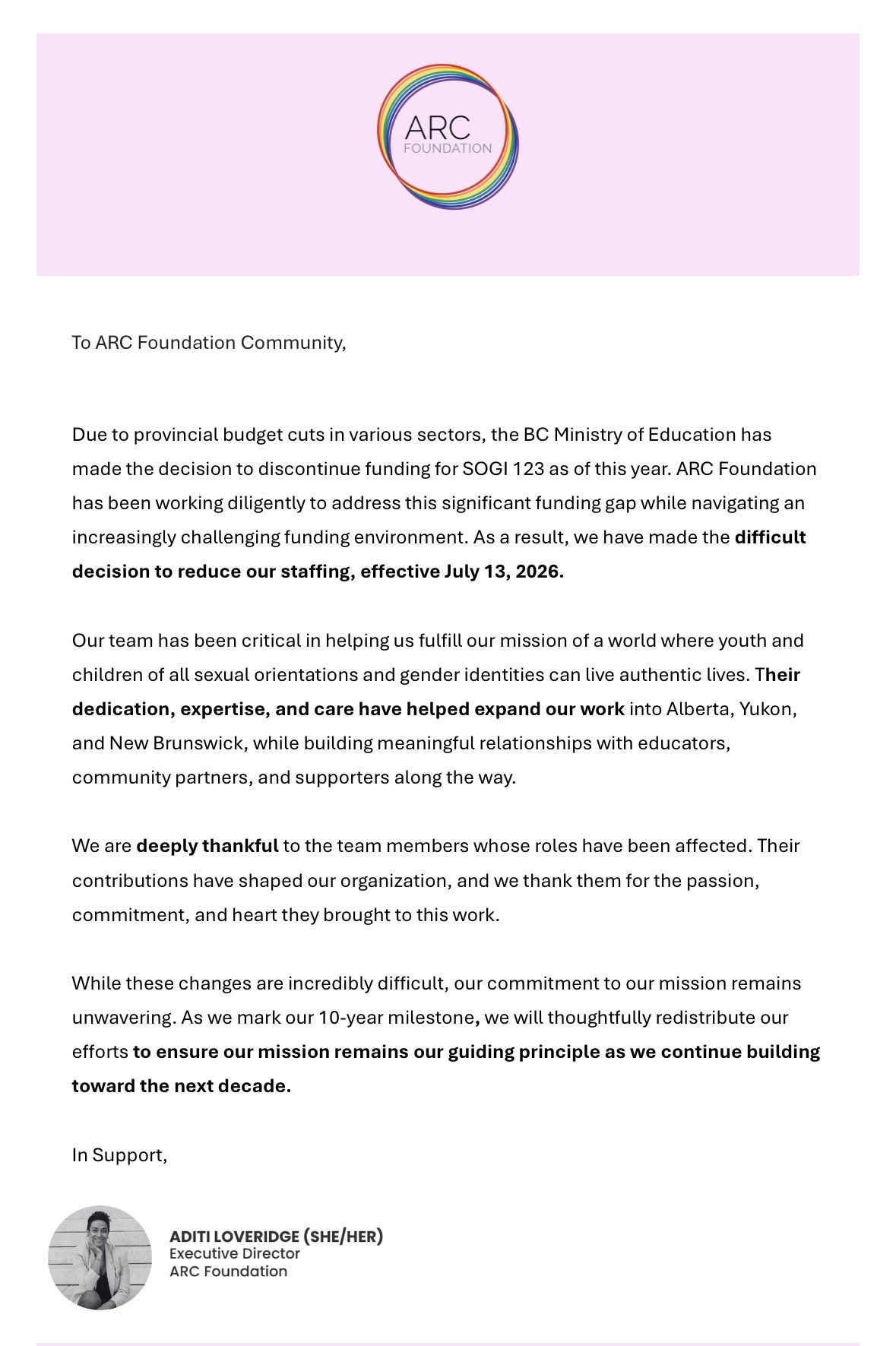
Minister of Education Lisa Beare initially said that the Conservatives were “lying”. Then in a statement to Island Social Trends said, “as a part of government’s commitment to responsible expenditure management, operating funding to the ARC Foundation, the organization that first created the resource, was reduced over time.” The statement went on to say the government stopped providing contract funding to develop new materials to the organization over two years ago.
After multiple attempts from reporters to get a clear answer from the Ministry, they finally admitted that, as of last month, all provincial funding has ceased.
That's… defunding. If you stop funding something, you've defunded it.
defund /dē-fŭnd′/ transitive verb
“To stop the flow of funds to.”
The American Heritage Dictionary of the English Language, 5th Edition
The ARC Foundation is still able to operate and the resources they’ve developed are still available, but they have been forced to lay off staff, reducing their capacity to develop new resources and provide direct support for teachers and students. Thankfully, at the classroom level little should change, as SOGI 123 is primarily a catalogue of age-appropriate resources teachers and administrators have the option to use. One of the reasons these resources are created and maintained by a charity instead of by the Ministry is to ensure independence and continuity if the government changes priorities. The BC Liberals may have suspected a future government would backtrack from the commitment they made to students back in 2016, even at a time when ARC’s work is becoming even more necessary.
The cycle
The BC Conservatives have spent a lot of political capital opposing SOGI 123. When Elenore Sturko crossed the floor from United to the Conservatives, she used her press conference to denounce the program she had supported only a few weeks earlier. Conservative candidates constantly spread misinformation to whip up opposition to the program. One of new leader Kerry-Lynne Findlay’s primary pitches was that she would lead the fight against safe schools for queer students.
Instead of defending it, the BCNDP ended their provincial funding, leaving the program that hundreds of British Columbians fought for with a shortfall. They have lost staff and capacity. Luckily, they still receive funding from the federal government, as well as donors (myself included, when I am able), so they will be able to keep their resources online. Teachers will still be able to use those resources to develop lessons that are inclusive of the fact that queer people exist, and administrators have access to guidance for policies and professional development. The organization will continue updating and developing new materials, but the provincial government is no longer funding that work.
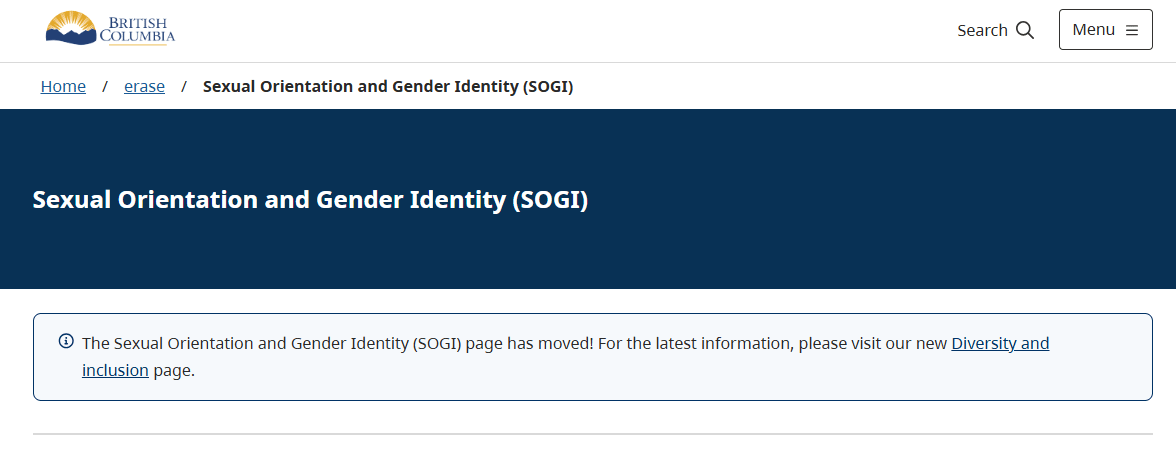
Meanwhile, the Ministry of Education quietly removed the dedicated SOGI page from their website, and rolled it into a generic “diversity and inclusion” page. The page previously provided a single homepage for in-depth information about the program and resources to counter misinformation in multiple languages.
Ironically, the day before it hit the news that the government had discontinued the funding, the nascent centrist party, CentreBC, announced their new leader: Mike Bernier, the Minister of Education who brought in SOGI 123 in the first place. He had been rejected from the BC Conservatives when they absorbed BC United for refusing to compromise his values and principles.
But the BCNDP have proven once again that when the going gets tough — or the budget — queer youth get left behind.
9-8-8 (call or text)
National Suicide Crisis Helpline310-6789
BC Mental Health & Crisis Response / no area code needed1-800-SUICIDE / 1-800-784-2433
BC Suicide Prevention and Intervention Line
For more resources click here.
Huge thanks to Mark Leiren-Young for help editing this post. Check out his blog, Forgive Us, We're Canadian.
You may also enjoy…
Vanishing history

“Every record has been destroyed or falsified, every book rewritten, every picture has been repainted, every statue and street building has been renamed, every date has been altered. And the process is continuing day by day and minute by minute. History has stopped.”
The pen is mightier

When I was in grade four, long before I realized I was gay, British Columbia was embroiled in controversy over three books. The books — Asha's Mums, by Michele Paulse and Rosamund Elwin; Belinda's Bouquet by Lesléa Newman; and One Dad, Two Dads, Brown Dad, Blue Dads
How many dead children is too many?

An undercurrent of the upcoming BC election has been the intensity of certain politicians attacking the queer community, in particular trans people. This is, sadly, not unusual come election time. The queer community is often used as a target for populist malaise.
Pride is a protest

It was the summer of 2005. I had just graduated high school, and that summer same-sex marriage was legalized. Ten days later, I got in a van and rode down to Vancouver to attend my first ever Pride.