
The most Conservative
The BC Conservative Party will have a new leader May 30

Hi! I currently make $7.12 per month writing this blog. It’s very appreciated — I buy myself a fancy coffee once a month thanks to the generosity of people on the internet! However, if you’ve enjoyed my writing over the last two years and want to throw a tip my way or become a monthly subscriber, I’d be thankful.
A few years ago, the idea that the BC Conservative leadership race would matter would have been laughable. The party used to be on the very fringes of provincial politics, mostly home to people who found the centre-right neoliberalism of the BC Liberal/United party to be tame for their liking.
Times have changed. BC United is a metaphorical zombie, pretty much obliterated under the leadership of Kevin Falcon. The BC Conservatives not only elected seats in the last election for the first time in decades, they formed official opposition.
As is their tradition, as soon as they got any momentum they ousted their leader, which is why they are now having a leadership race.
The race has whittled down from 11 candidates at the onset to only five left standing. The remaining contenders present possible different directions for the newly powerful Conservative Party.
The withdrawn
Six candidates put their names forward at the start of the race, only to withdraw and throw their support behind someone else.
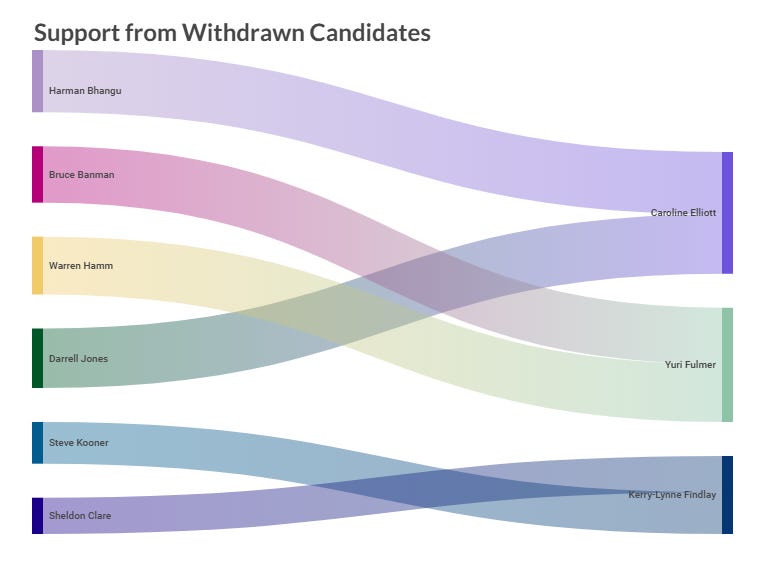
Northern and Richmond MLAs Sheldon Clare and Steve Kooner endorsed former Surrey MP Kerry-Lynne Findlay. Fraser Valley MLA Harman Bhangu and former Pattison Vice President Darrell Jones dropped out to endorse former BC United Vice President Caroline Elliott. Another Fraser Valley MLA Bruce Banman and Rossland contractor Warren Hamm withdrew and endorsed Yuri Fulmer, who ran in the last election and was defeated by the Green Party.
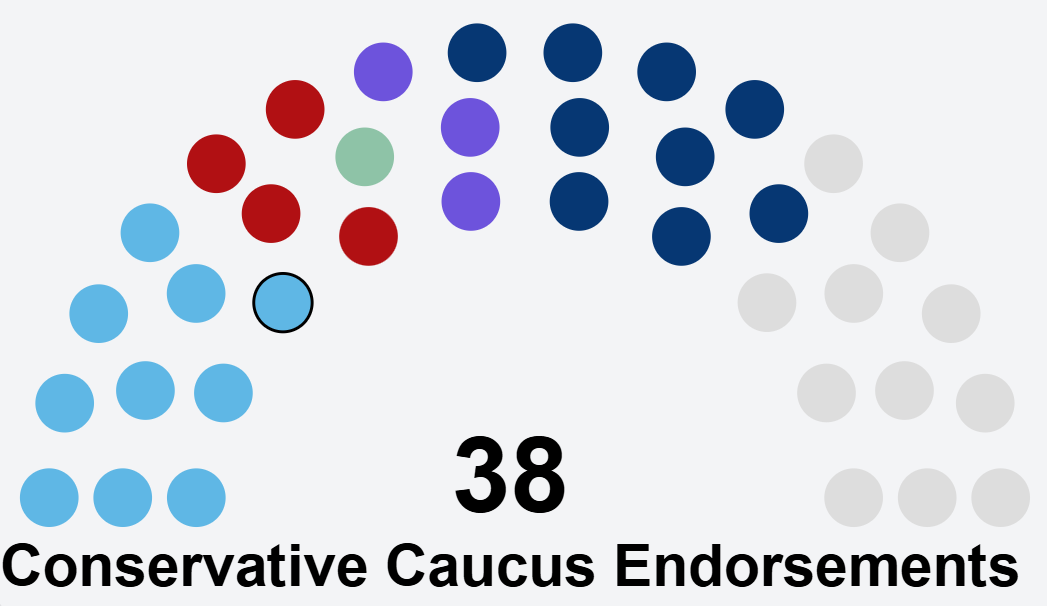
The remaining candidates are current Kamloops MLA Peter Milobar and former BC Liberal cabinet minister Iain Black. While they did not receive support from withdrawn candidates, Black has the endorsement of four current members of the Conservative caucus (Teresa Wat, Misty Van Popta, Korky Neufeld and Tony Luck). Milobar has 9 current and nine former MLAs endorsing his bid, meaning 24% of the elected Conservative caucus would like him to lead their party (26% if you include Milobar himself). That ties him with Findlay, who also has the support of 9 currently elected MLAs.
By the numbers
Following the withdraw of the six former candidates, the race has tightened around the five remaining ones.
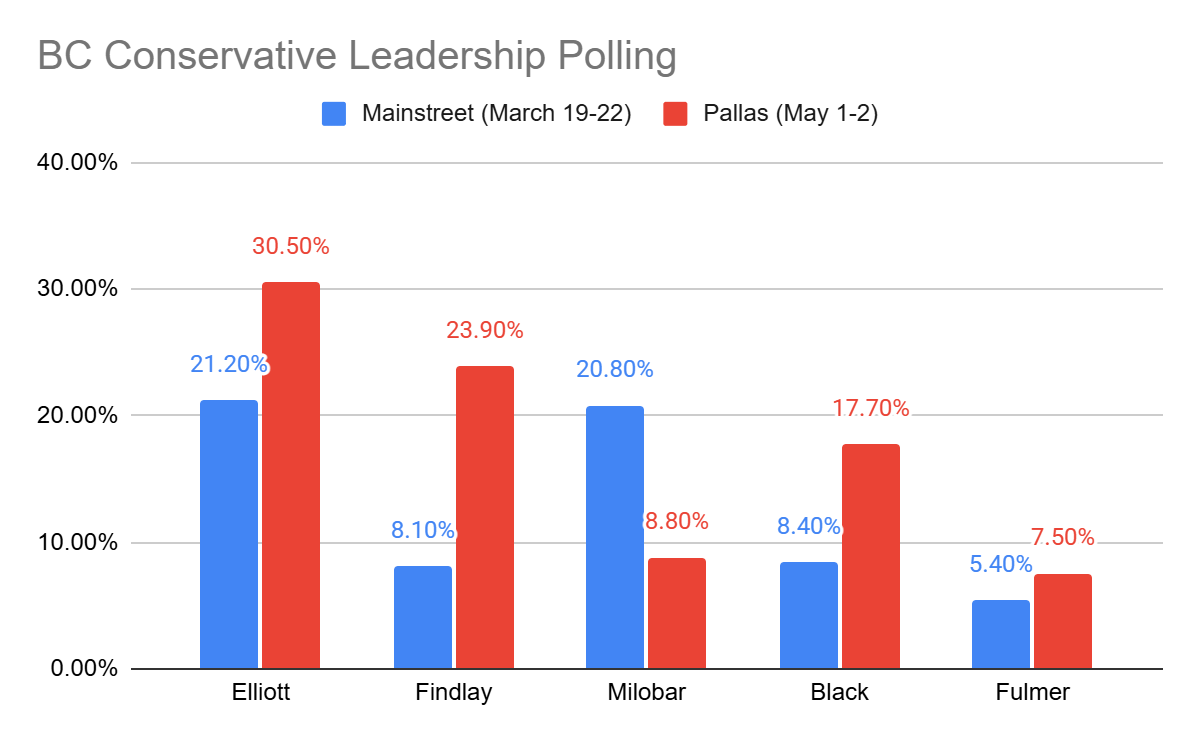
Two polls have been conducted on Conservative members, one in March by Mainstreet and one at the beginning of May by Pallas Data. Both polls showed Caroline Elliott in the lead, but differed on the rest of the race. Pallas’ poll was commissioned by Elliott’s campaign, and Mainstreet’s was commissioned by Milobar’s.
On the other hand, my DIY leadership model shows a completely different story, though it does agree on one thing — Elliott is probably in the lead.
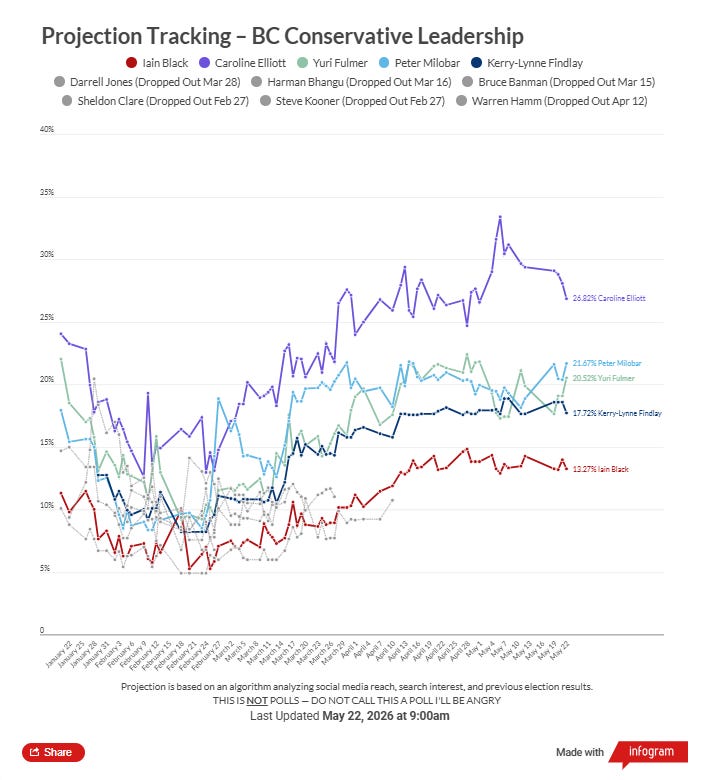
That being said, my model missed the mark in the BC Green leadership race, and leadership race polling can be notoriously difficult, so these numbers are at best an educated guess.
To the right, to the right
If the BC Conservative leadership race could be distilled down to a single ballot question, it would likely be whether the party should be a big-tent political coalition, in the style of the successful BC Liberal or Social Credit parties, or if the party should be an vehicle of social conservative orthodoxy similar to Bill Vander Zalm’s time as Social Credit leader and the role the BC Conservatives previously played as a fringe organization.
On the side of the big tent coalition are Peter Milobar and Iain Black. Both have roots in the BC Liberal Party and have played major roles in government. Both have held different cabinet positions and managed complicated portfolios that required bringing divergent perspectives together. Milobar was formerly the mayor of Kamloops, as well as finance critic and house leader for BC United. Black served under Premier Gordon Campbell as Minister of Labour and Citizens Services and then Small Business, Technology and Economic Development.
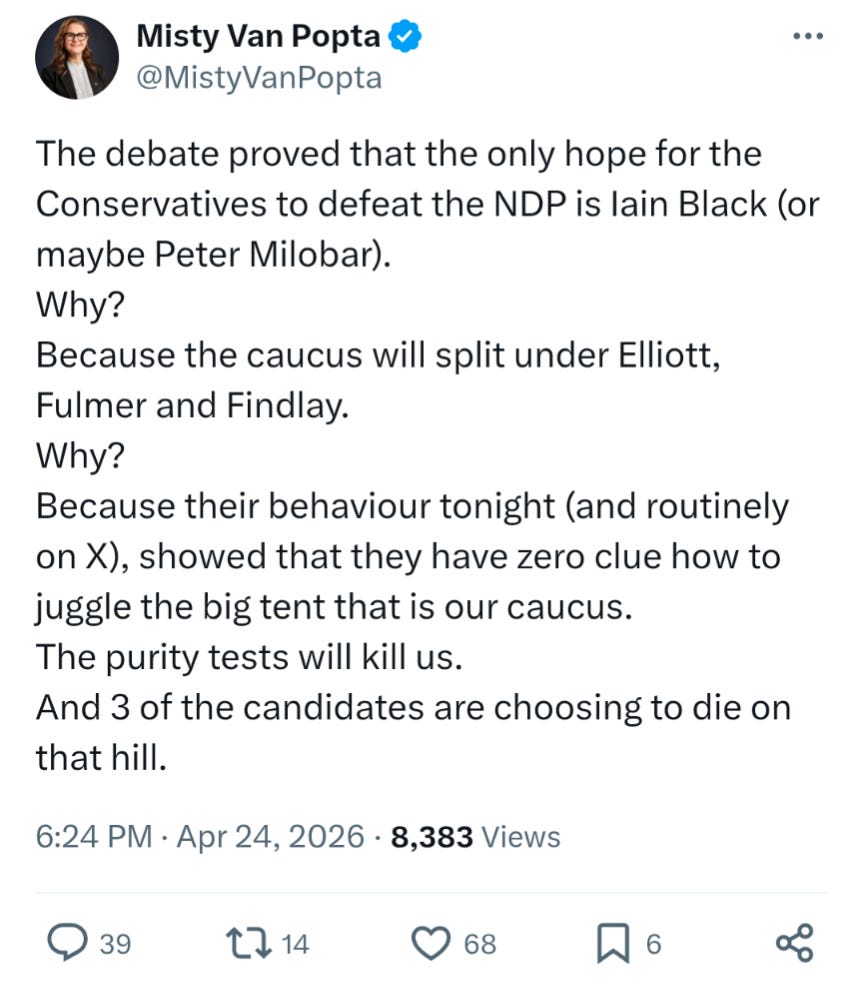
On the other side has been Elliott, Findlay and Fulmer, who have argued over who is the purest distillation of orthodox conservatism and attacked each other as insufficiently right-wing to lead the party. Elliott, previously the Vice President of the BC Liberals and later BC United, has abandoned the big tent philosophy of her former party, as well as some of their initiatives and policies. One of her recent focuses in her communications has been praising anti-queer author who recently started denying aspects of the Holocaust, J.K. Rowling.
Findlay has fought to bring the federal Conservative approach of Pierre Poilievre to the provincial party, with a particular focus on getting rid of the voters who came over from the BC Liberals (which was a conservative party). Findlay received the endorsement of independent Tara Armstrong, who has used fascist slogans in the legislature and advocated for the extinguishment of free expression. She also attacked Milobar for having an Indigenous wife.
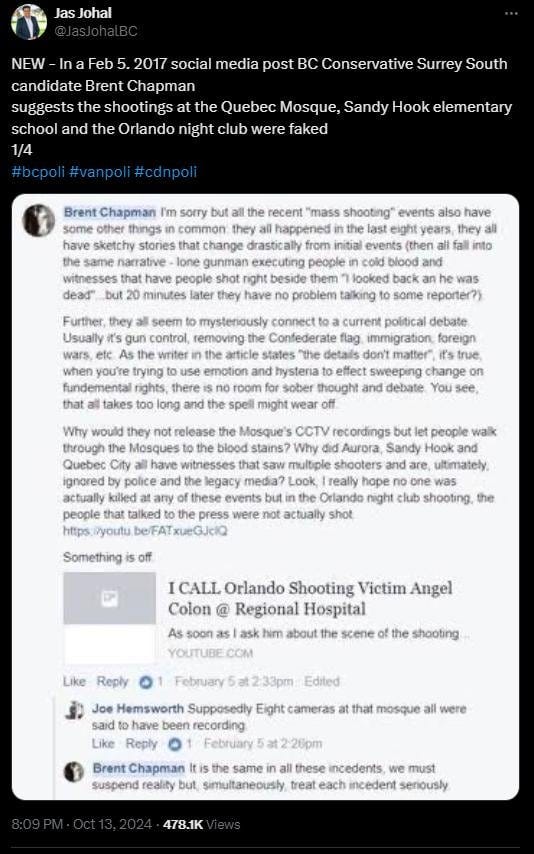
Fulmer started the campaign by pitching himself as a uniter who could lead a big tent organization, but flipped to the other side by rebranding himself as a firebrand conservative who would pull the party even further to the right. He promised to strip human rights protections based on gender from the Human Rights Code, and aligned himself with the far-right OneBC, committing to surrendering five seats to the fringe party if elected leader.
OneBC is led by Dallas Brodie, who was elected as a Conservative but could not work with the caucus and was ejected after a series of conflicts. It is likely some existing members of the Conservative caucus would be uncomfortable with aligning with her again after being burned the first time.
The math
The BC Conservatives will use a proportional system to allocate points to candidates based on support in ridings across the province. Unlike the BC Green leadership last year, in which each member had one vote and the winner had the most votes, Conservative members will be weighted against how many voters are cast ballots in their riding.
That is, if Conservative members are even able to vote. Like the BC Greens, the Conservatives have implemented stringent verification protocols for members before they can vote. Unlike the Greens, however, the Conservatives require every member to verify, and the only method for verification is to provide all your personal information to a US company. There is no alternative — either cough up your data or you don’t get to vote.
Each of British Columbia’s 93 ridings are allocated 100 points. In a riding with fewer than 100 ballots cast, the riding will have as many points as ballots cast, e.g. if 64 ballots are cast, that riding has 64 points and each ballot is worth 1. In ridings where more than 100 ballots are cast, they will be divided to equal 100 points, e.g. if 546 ballots are cast, each ballot will only be worth 0.18 points. This is intended to ensure one riding cannot dominate the voting process and elect someone who does not have province-wide appeal.
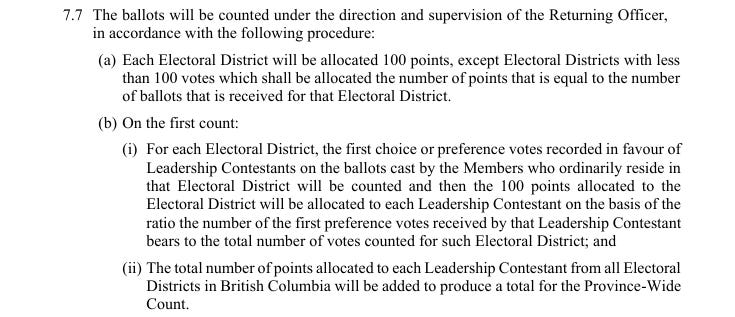
If no candidate has 50% support on the first ballot, the lowest ranking candidate is eliminated and their votes redistributed to whoever those voters chose as their second choice.
Down-ballot projections are even more difficult to predict than estimating the level of support candidates will get on the first one, but I made some educated guesses and this is how it might go down.
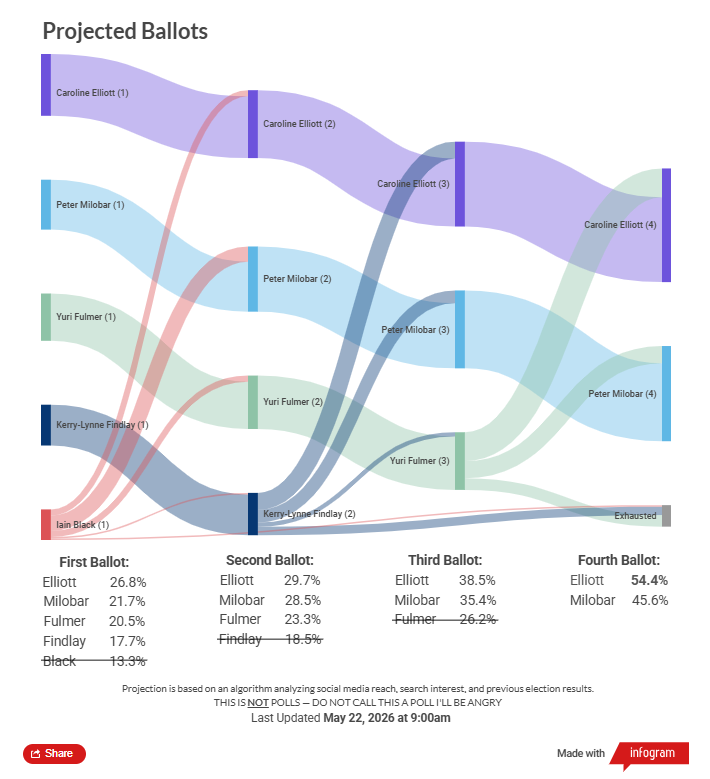
My model has Iain Black being eliminated first, which would likely benefit Peter Milobar. However, Findlay’s support splits between Elliott and Milobar, and Fulmer’s support mostly goes to Elliott, leading to her winning on the final ballot.
Maybe. This projection is mostly guesswork, so take it with a whole shaker of salt.
The outcome
Whoever takes the lead of the BC Conservative party will become the leader of British Columbia’s official opposition — once they have a seat in the Legislative Assembly. Only Peter Milobar is currently elected, so if any other candidate wins they will need to run in a by-election, which would likely require an existing Conservative to step down. The same thing happened to Premier Christy Clark when she became leader of the BC Liberals in 2011.
Once settled into their role, their job will be two-fold. They will need to hold Premier David Eby and his NDP government to account, and present alternatives to the government’s policies and proposals. The Conservatives are still polling high, and can be seen as the government-in-waiting if the NDP lose public support.
Their other job will be to keep the raucous Conservative caucus together — a job former leader John Rustad struggled with. The current group of Conservatives include free-market neoliberals and orthodox social conservatives, which is a difficult coalition to keep together.
The Conservative’s new leader will be chosen May 30th.
You may also like…
A brief history of right-wing coalitions governing British Columbia

There will not be some kind of United Conservative Coalition Party on the BC ballot this election. Depending on who you ask, either United or the Conservatives walked away from the table, and curse words may or may not have been uttered. Social media was a communications race to see who could frame the narrative the fastest.
Eulogy for BC United (formerly BC Liberal Party)

The last couple weeks have been some of the most chaotic in British Columbia political history. While BC is full of parties that have risen and fallen, never before has the Official Opposition completely collapsed and folded before an election.
The cancel caucus cometh

Way back in 2007 I lived in Vancouver, and was tangentially connected to the comedy scene through an improv troupe. Around this time, a comedian named Guy Earle performed at a Commercial Drive venue. It did not go well.
Exactly what they signed up for

When Kevin Falcon stood next to John Rustad and announced his unconditional surrender in the 2024 BC election, Conservative candidates across the province celebrated the incredible increase in their chances of being elected to the legislature. One was affected more than any other the others — Dallas Brodie, the Conservative candidate for Vancouver-Quilc…


Unserious people doing unserious things

Over the winter holidays a bizarre soap opera unfolded in British Columbia politics. The nascent far-right political party OneBC completely imploded. Three of the four directors of the party amended their constitution to allow them to expel their leader after she demanded they fire a junior staffer who appears to be an